Turning a bedroom closet into a workable office nook
 RUTH WILLIAMS·5 min read·August 1, 2026
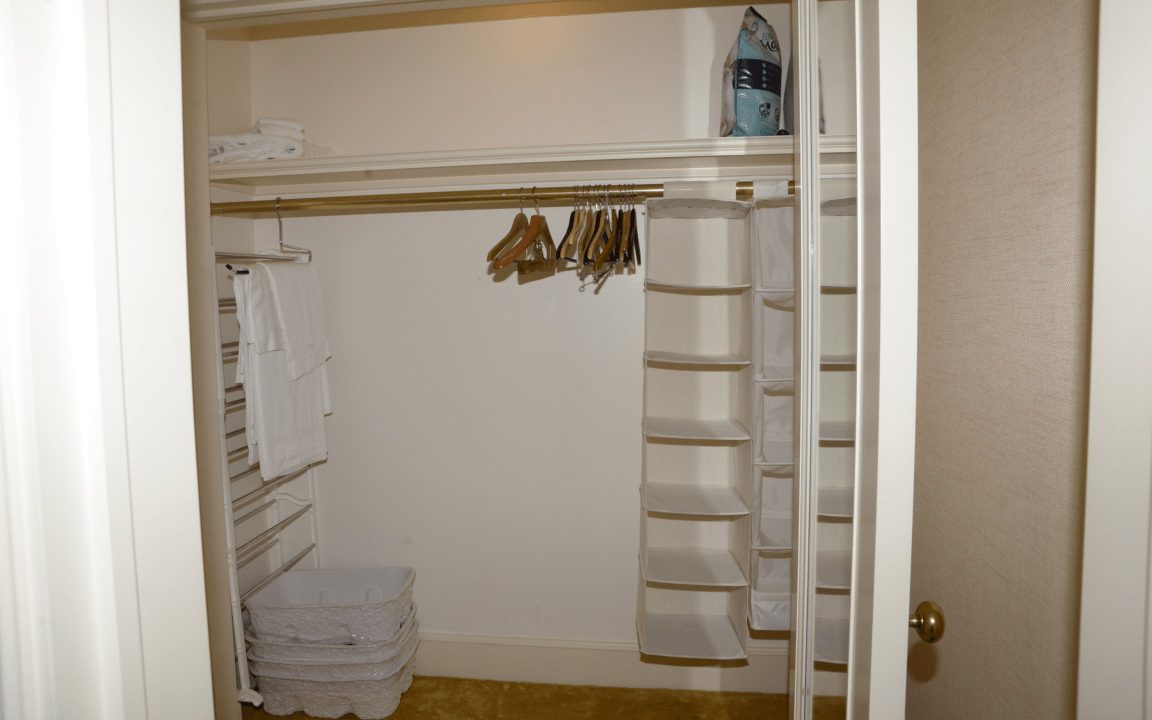
A bedroom closet is a workable office only if you solve the chair before the desk. Almost everyone does it the other way round.
The closet that was almost deep enough
Owen’s flat was built in the seventies, when a bedroom closet was 58 cm deep and 118 cm wide. It held coats and a vacuum cleaner and nothing else.
He measured it on a Tuesday and ordered a 110 cm desk on the Wednesday. The desk arrived before he checked how a chair would fit.
The closet was almost deep enough, which is the most expensive kind of almost. Two centimetres of depth decided the whole project before it started.
Why 58 cm fails a chair
A chair needs about 75 cm from the desk edge to the wall behind for a seated adult. The closet offered 58 cm and a door frame.
Owen could sit, but only with his knees against the side wall. The desk had to be rotated so he entered from the corner.
Rotating cost him the width. A 110 cm desk across a 118 cm opening leaves 4 cm on each side for a body to pass.
Removing the doors and what it costs
The sliding doors came off in twenty minutes and gave him 6 cm of depth at the front. They also exposed the frame and the track.
Without doors the closet read as a recess rather than a room. That helped the light and hurt the conversation with his landlord.
He stored the doors under the bed and told himself he would refit them. Eight months later they were still under the bed.
The depth a curtain gives back
A curtain hung inside the opening costs 2 cm and closes the recess when he stops working. It is the cheapest door that is not a door.
Owen used a heavy cotton panel on a track fixed to the closet ceiling. It deadened some sound and hid the desk completely.
The curtain does not seal, so the closet stays ventilated all day. That mattered more to him than the tidiness it provided.
Ventilation when the door closes
A closet with a closed door and a person in it reaches high carbon dioxide within an hour. The symptom is a dull headache people blame on screens.
Owen measured 1,800 parts per million after fifty minutes with both doors shut. With the curtain left open it stayed near 700 through the afternoon.
The fix was not a fan but an opening. Any closet office needs a permanent path for air, even in the coldest week of winter.
Heat from a laptop in a box
A laptop and a monitor in an enclosed volume raise the temperature faster than in a room. Owen’s closet ran 4 degrees warmer than the bedroom.
The fan ran constantly and the machine throttled during long calls. Heat is the hidden cost of working inside a small sealed volume.
He moved the laptop to a stand outside the closet and ran one cable in. The temperature dropped and the fan noise left his microphone.
The door choice that worked
Sliding doors waste 6 cm and jam on a track that collects dust. Bifold doors fold into the room and block the corner where the chair goes.
Owen tried bifold doors for a month and then removed them. The panels fouled the chair every time he stood up from the desk.
The curtain won because it has no swing at all. In a closet, anything that moves needs space the closet does not have.
Lighting inside a closet
A recess has no window and no ceiling light, so the desk needs its own source. Owen fixed a strip under the closet shelf.
The strip lit the keyboard and left his face in shadow for calls. He added a small panel at monitor height and the calls improved.
Two light sources in 1.2 square meters is not excess. It is what replaces the daylight the closet never had at any hour.
The shelf above the desk
The closet came with one shelf at 180 cm, above head height when seated. Owen kept it and put the printer and paper there.
That shelf became the only storage, which meant the desk stayed clear. The height made it useless for anything he used daily.
He added a second shelf at 140 cm for the router and the power strip. Both sit above the monitor and out of the sightline.
Sound inside a small box
A closet with a curtain is slightly quieter than the room, mostly because clothes and soft panels absorb reflections. It does not stop sound leaving.
Owen’s calls were audible in the bedroom through the open top of the recess. The curtain changed the tone rather than the level.
He took calls with a headset and kept his voice down, which was the only real control. Small rooms flatter the microphone and punish the neighbour.
The smell and the old plaster
The closet had been closed for years and smelled of old plaster and damp. Owen found mould behind the skirting on the left.
He treated it, ran a bead of sealant along the frame and left the recess open for a fortnight. The smell went and did not return.
An enclosed workspace concentrates every smell in the flat. If the closet smells of anything, that thing is now in your lungs.
What he would do differently
Owen would start with chair clearance and work backwards to desk size. The desk was the only thing he measured before buying.
He would also leave the doors off from the first day instead of the third week. The doors cost him a fortnight of stale air.
The setup works now and cost less than a desk and chair together. It works because he stopped treating the closet as a room.
If your only spare space is a recess with no window, is a curtain enough of a door for eight hours a day?