Clearing a small home office desk at the end of the day
 RUTH WILLIAMS·5 min read·August 5, 2026
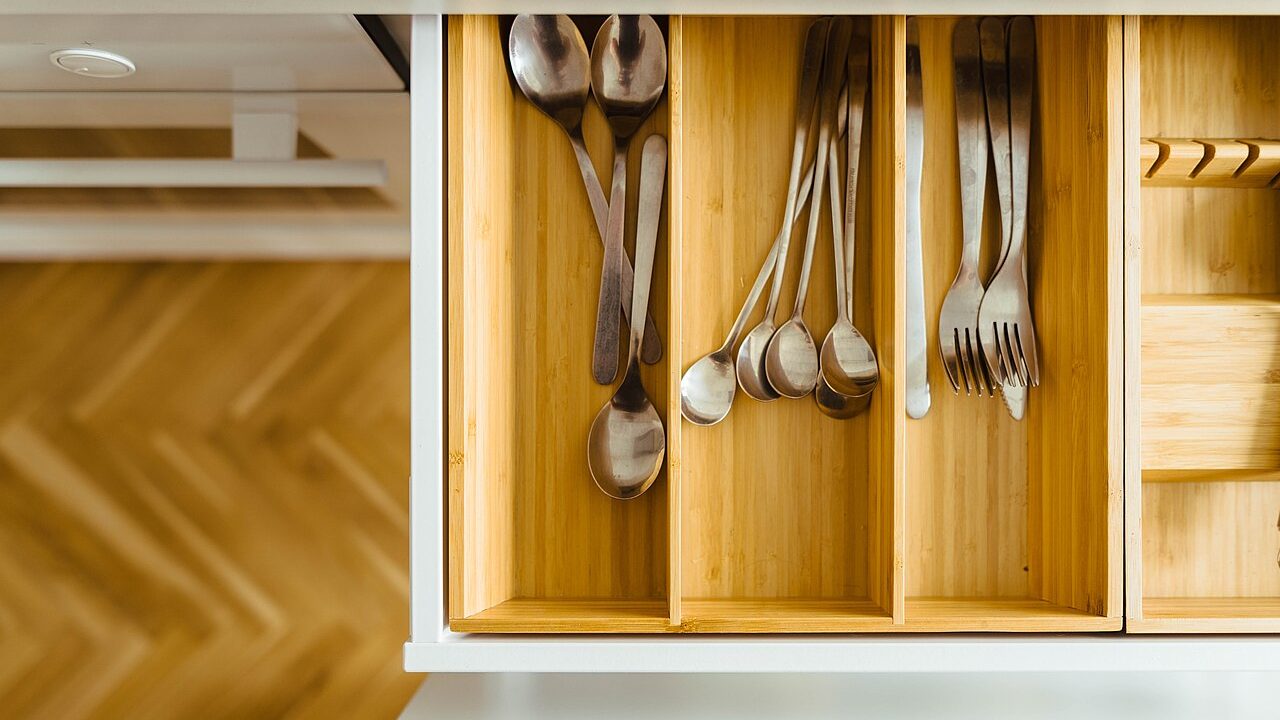
A desk in a small flat is never cleared by discipline; it is cleared by having somewhere for the things to go. Storage comes before habit every time.
The desk that never got cleared
Marcus worked in a 9 square meter room that was also his living room, and the desk was the first thing a visitor saw. It was covered by six most evenings.
He tried clearing it each night and the clearing took twenty minutes. Anything that takes twenty minutes stops happening by the second week.
The desk was not the problem at all. The room had no place for the things that arrived on it during a day.
One box, one drawer, one rule
He bought one lidded box that fitted under the desk and one drawer unit beside it. Everything that landed on the desk had to fit in one of them.
The rule was about volume and not about tidiness. If the box lid closed, the day was over, whatever was still unfinished.
A container with a lid sets a limit that a surface does not. The desk had been absorbing clutter because it had no bottom.
Why the landing zone forms
Clutter collects where the hand arrives before the storage does. In Marcus’s room that was the near end of the desk, by the door.
He put the box at that end and the pile moved into it without any habit change. The distance from hand to container was the whole mechanism.
This is why a tidy desk in a photograph rarely survives a working day. Storage has to be where the arrival happens.
Vertical storage in a small room
Floor space in 9 square meters is worth more than wall space, so storage should go up. Marcus added two shelves above the desk at 150 and 190 cm.
The lower held the printer and the upper held archive boxes he touched twice a year. Both sat above his seated sightline.
Height is the only dimension a small room has spare. Every horizontal surface he added had to be mounted off the floor.
The shelf depth mistake
He first used 35 cm shelves because they were cheap and held more. They also put a hard edge 50 cm from his face on video calls.
The shelf above a desk is in the camera frame whatever you intend. Marcus’s calls showed a row of cardboard and a shadow.
He replaced them with 22 cm boards in the same positions. Less went on them and the calls looked like an office again.
Cables as clutter
Half the mess on the desk was cable, and most of it belonged to things that never moved. Marcus counted seven cables for four devices.
He bundled the fixed ones under the desk with adhesive clips and left two loose. The surface gained a third of its area back.
Cables read as clutter even when they are orderly, because they cross the surface at angles. Under the desk they stop being visible and stop being a task.
The printer problem
The printer was the largest object on the desk and printed four pages a week. It occupied a quarter of the surface for one percent of the work.
Marcus moved it to the shelf above and ran the cable down the wall. The desk felt twice as wide without anything being removed.
Every small office has one object that earns its space monthly and occupies it daily. Finding that object is most of the work.
A closing ritual that takes four minutes
The routine is four steps: lid on the box, drawer shut, chair pushed in, lamp off. It takes under four minutes once the storage is in place.
Marcus did it for three weeks before it became automatic. The first week felt like tidying and the third felt like leaving.
A ritual works because it is short and ordered. Twenty minutes of nightly sorting becomes a project, and long projects get postponed.
Where the chair goes
A chair pushed back from the desk takes 70 cm of floor and makes the room read as occupied. Marcus pushes his in and turns it to face the wall.
The turned chair signals that the room is now a living room. It is a small physical act with a large effect on how the space feels.
In a room with two uses the transition needs a physical marker. The pushed-in chair is the cheapest marker he could find.
Storage that hides work from you
Everything in the box is out of sight, including the notes he needs tomorrow. Marcus keeps one folder on the desk for the next morning.
That folder is the exception that makes the whole rule work. Total concealment would mean unpacking the entire day before starting the next one.
The goal is a clear surface and not an empty one. One folder and one pen still counts as a clear desk.
The camera background at short notice
Visitors and video calls arrive without warning, and the wall behind the desk is the first thing either sees. Marcus kept that wall to one shelf and a plant.
Everything else went to the side wall, out of the camera angle. The desk could be messy at four and presentable at four-oh-one.
Designing for the camera is designing for the room’s worst angle. Fix that angle and the rest of the room follows from it.
What to remove permanently
Three things never came back to the desk: the printer, a second monitor used twice a month, and a stack of trade magazines. None were missed.
Removing them was not decluttering, it was admitting what the work involved. The desk then held only the work that actually happened.
Storage is the second answer to clutter on a desk. The first is simply having less of the thing that needs storing in the first place.
If clearing your desk at the end of the day took four minutes instead of twenty, would you still be thinking about a bigger room?